Showing posts with label home recording. Show all posts

Tuesday, March 11, 2014

3 Songs, 3 DAW's, Part 3 (The Finale) - Reason 6.5

First post of 2014! I'm back once again with another new track, which will conclude my "3S3D" series of posts. So as usual, I will start off with a link to the track, before I get all into it...


This track was created using Propellerhead's Reason DAW, starting way back in the summer of 2012. As I mentioned in the last post, my original plan was to do the Reason track as Part 2 of the series. Due to creative issues with this track, I decided to put it on the shelf, and skip ahead to work on another track with my old standby, Pro Tools.

The song was originally written back in 1999, making several attempts over the years to record a proper version. The basic structure hasn't changed too much from how I originally wrote it, but it's certainly gone through some editing and revisions this time around. Writing songs like this one back in my earlier days, I was much more inexperienced, and struggled with what I know now as "song arrangement". I may have known what the chords were, but there's probably several different ways to play those chords... Chord progressions, tempo, key signatures, rhythms, they can each have a million different variations, and a million combinations of those variations! It can be hard to make a choice sometimes, but the bottom line is that eventually you have to eliminate all those options, and settle on something. This recording is the end result of me settling on something, haha...

The track was arranged around a single static drum loop, similar to how sample-based tracks were done back in the late 80's to early 90's. I appropriately and unashamedly jacked the loop from a friend's old song demo cassette tape from 1997 or so. I used a sampler inside Reason to re-arrange the beat to suit my song. Getting the track together was a slow process for sure, but I stuck with it and eventually got it done. Not perfect by any means, but I'm fairly pleased with how it turned out.

Until next time...

Wednesday, September 4, 2013

3 Songs, 3 DAW's, Part 2 - Pro Tools 10

Back once again, with part 2 of the "3S3D" series. Yes, I realize this series is VERY slow going, but rest assured I'm determined to see it through to the end. If you wish to hear the final results now, feel free to click below...


For this second installment of the series, I originally planned to record a song from scratch, using Reason 6 as my DAW of choice. However, at some point I realized things track were not working out the way I had hoped. My problems were with motivation and inspiration. Motivation to record a song from scratch using a program I'm not very familiar with (which, unfortunately, was exactly what this task entailed!). And inspiration to come up with a track, arrangements, production ideas, etc. So in the meantime I decided to re-work and re-mix one of my old projects and see what I could do with it using Pro Tools, so I could get  some sort of project completed, using tools I'm much more familiar with.

This instrumental originated as a basic "idea" sort of track that I recorded back in 2004, using Pro Tools LE on my first Power Mac G4. The title "Saturday" has no significance really, other than it was the day on which I recorded it, and I couldn't think of anything better... This was a long time ago, but I'm fairly sure that all the instruments were recorded all in one day in a single session, different from how I record these days, to be sure. At the time I believed that I would some day come up with some lyrical ideas and turn it into a "song", but nothing has come to me so far. So until that day arrives, it will continue to live out its days as an instrumental.

As far as the changes that I made from the original version, I did a bit of editing to delete some parts of the original arrangement, which was about 4:30 long. I felt it needed to be shortened in some sections, just to keep things moving along, so to speak. As you can see from the Soundcloud timeline, this new version clocks in at 3:22. The edits were made to hopefully keep from boring the listener too much. Because this was born as an "idea" track, I didn't really play all the parts as tightly on the beat as I could have. So after listening to it again 9 years later, it was apparent that some fixing of parts here and there was needed, using a bit of editing "magic". Some of the new arrangement ideas were born out of necessity for the same reason. As much as I would have loved to re-record certain parts, I decided to simply work with what was already there.

I decided to re-visit this piece because I still like the musical idea, and my overall skills using Pro Tools have much improved since 2004. Especially since the past 3 months or so, I feel that I have much more of an idea of what I'm doing as far as mixing goes. Some newly acquired skills in using Pro Tools itself, as well as general mixing skills, seemed to help out quite a bit in finishing this new version. In fact, this just may be a new upcoming "experiment" of mine; to continue re-visiting more of my old Pro Tools recordings, and re-mix them to more "listenable" standards...

Now, on to the software. As I mentioned before, I recently upgraded my Pro Tools from LE 8 to version 10. In detail, Pro Tools 9 was bundled with the new Mbox audio interface I purchased last year. But I had no intention of using PT 9 at all. Since PT 10 was already out when I bought the Mbox/PT 9 bundle, I was allowed to upgrade to 10 free of charge. Perhaps I'll talk about my experiences with the new Mbox in a future post.

After putting this new version through its paces, I would say that I'm very pleased with it. Although there weren't any life-changing improvements in this version, there were some incremental ones that improved my workflow, and allows me to get the results I'm looking for.

Pro Tools' Edit Window.

Mix Window.
Version 9 (I chose to skip this upgrade) introduced the ability for Pro Tools to be used with "3rd party audio interfaces"; meaning audio interfaces other than those sold by Avid (the company that develops and sells the Pro Tools software), as well as the option of using your computer's native audio outputs, eliminating the need to a separate audio interface at all. This feature is fairly new for Pro Tools users, as they previously required the use of the interfaces to use the software at all. So, this little convenience may come in handy for me someday.

Secondly, Pro Tools 10 comes with standard with a new "channel strip" plugin, which allows you to get right down to business of the most important audio processing you will do as a DAW user. This plugin emulates the functions of the audio channel of a large format audio mixing console, the kind found in the big-time commercial recording studios. These mixing  console channels typically include EQ, Compression, Expansion, and Gating controls. Without a plugins like these, you can certainly get the job done with individual plugins of each type of effect you need, but it's convenient to have all these functions in a single plugin. I also recently treated myself to the SSL 4000 Collection bundle, by Waves. Part of this bundle includes my new favorite plugin, the SSL E-Channel. This plugin as well as the others in this bundle are emulations of legendary SSL mixing consoles, used to record and mix hit records too numerous to mention. After using both the Avid Channel Strip and the SSL plugin on this mix, I must say that I am a new fan, and will continue to use them on other projects to come. These types of plugins helped me to limit my choices of effects and other processing in a positive way, and apply more focus to getting the mix done.

Avid's Channel Strip Plugin, comes standard with Pro Tools 10.
Waves SSL E-Channel Plugin.
A new feature in Pro Tools 10 is Clip Gain, which allows you to reduce the amount of gain (volume) on a section of audio in your project on-the-fly and in real-time, without having to process and create a whole new audio file similar to older versions of Pro Tools. Also new are features to let you automatically import your new mix into your iTunes library, and upload to SoundCloud as well as Gobbler, an online storage and file sharing website, seemingly geared towards audio and other media creators. The "import to iTunes" feature was especially handy in quickly checking out new mix versions. These handy little features make Pro Tools 10 a nice, if not a "can't-live-without" upgrade for me.

Pro Tools' Clip Gain feature allows changes in volume to individual pieces of audio in real-time.
In some way it feels strange to be "reviewing" these DAW's at this point in time, because I'm always a bit behind the times. It seems that by the time it takes me to post a new piece of music, the DAW that I'm talking about has already been upgraded to a new version. Pro Tools is now on version 11; Reason was also updated to version 7 earlier this year; and just this past July, Apple FINALLY released Logic Pro X.


However, I understand that it doesn't matter in the big scheme of things. For one, just because these DAW's have moved on to new versions, it doesn't mean that I can't continue on with my "experiments" simply using what I have, which are great tools in their own right. They perhaps don't have the shiny newness of whatever version they happen to be on at the moment, but does not in any way hinder me from making music.


Secondly, it looks like the computer system requirements for all 3 new versions are beyond the specs of my current laptop; so, apparently I couldn't upgrade to them if I wanted to. It doesn't really bother me, though. The software versions I'm working with are MORE than capable of being the tools I need to produce some high quality recordings. I remember when all I had to record to was a cassette boombox, so I've got to keep some perspective. I'm still learning and re-learning the important lesson of not focusing on the "tools" themselves (as cool as they are!), but actually learning and using these tools to actually create SOMETHING.

Soon I will start working on my new track in Reason 6, for the 3rd and final installment of this series. Until next time...

Sunday, May 12, 2013

3 Songs, 3 DAW's, Part 1 - Logic Pro 9

I've finally completed the first entry of my "3 Songs, 3 DAW's" experiment. For those who don't care to read my ramblings below and simply want to hear the track, here it is...


Avid's Pro Tools was my introduction to computer-based recording, and has since been my recording platform of choice. It wasn't my introduction to digital recording in general, because I'd been using (and still own) an 8-track digital recorder called the Roland VS-880EX since 1999, then got my first Macintosh G4 in 2003 to run Pro Tools LE. As time went on, I would read about the intriguingly cool features of other DAW's on the market, and figured this project would be a good way to explore what other DAW's have to offer, and satisfy my curiosity.

I recorded and mixed the song above in Apple's Logic Pro. Much like Apple's computer hardware lines, many of their software titles are divided into "professional" and "consumer" categories. In the case of their audio software, Logic Pro is their "professional" DAW, the "consumer" level  program being their also-excellent Garageband, which comes installed with a new Mac computer purchase.

Logic's history actually goes back to the early 90's, originally developed by a company called Emagic, and then was purchased by Apple in 2002. Logic has been a Mac-only program for a while now, but before Apple bought Logic, it was available for both the Mac and Windows. Once Logic became an Apple product, they initially had two versions, Logic Pro and Logic Express, which is my first experience with the software, and I later upgraded to the Pro version. Apple have since discontinued Logic Express, and now carry on with Logic Pro and Garageband.

Overview of Logic Pro's Main Window.

Below are some observations on Logic Pro, describing some feature and workflow comparisons to Pro Tools, in no particular order:

Audio Region Editing - The most major learning curve for me was in this area. From a Pro Tools user's perspective, Logic Pro's editing tools seemed a bit foreign at first. However, with some of time and practice, it got easier. On the plus side for Logic, they have what's called a "Smart" time grid setting, allowing the user to easily and quickly select exactly what section of audio they want to edit with the mouse, depending on the zoom level they're using in the Edit window. It accurately "snaps" your highlighted selection to the grid for whole bars of audio, or way down to the super-detailed waveform transient level. Pro Tools' Edit window gives the user many of the same edit options, but the grid "snap level" has to be selected manually.

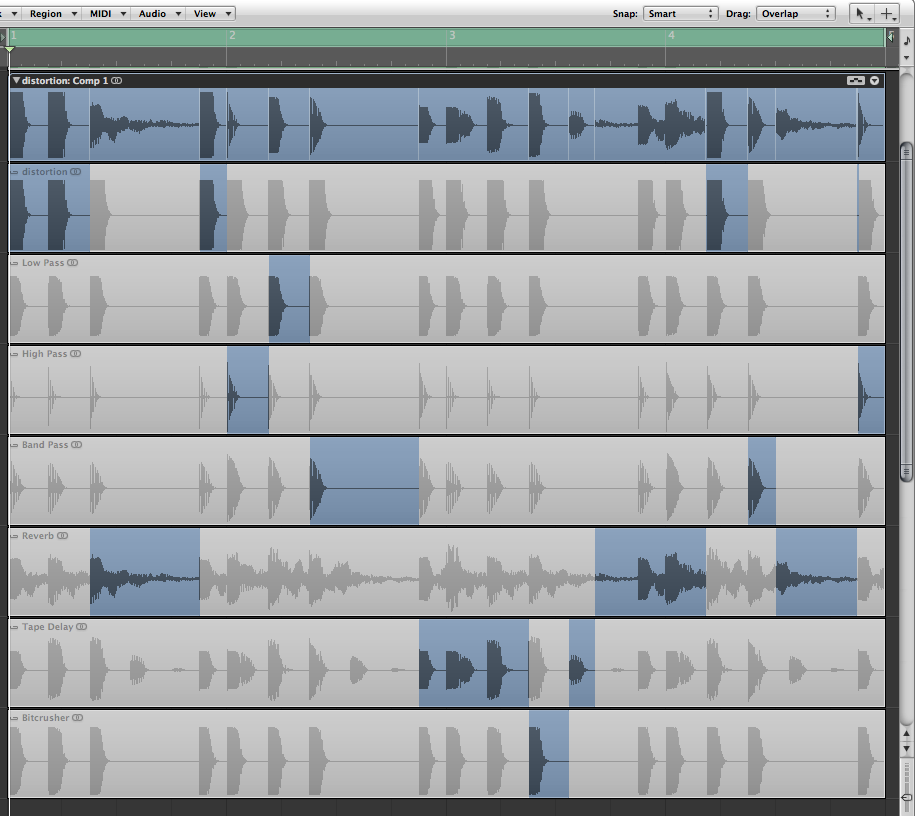
Composite (Comp) Track Editing - Here's an area where I feel that Logic Pro has the advantage. Their "Quick Swipe Comping" feature is well implemented, and probably my favorite feature. Very easy to audition sections of multiple takes by simply swiping the area of the region you want to hear, and clicking that area in a different take lane to hear an alternate version of that particular section - very intuitive. Pro Tools' version of that feature is not bad, but you have to click a "solo" button for each take lane you want to audition, then click another button to commit to the comp selections that you chose. These extra steps makes the process a bit "clunky" in comparison to Logic Pro. A minor gripe perhaps, but I see all those extra mouse clicks adding to the total time spent editing your tracks. Logic Pro also inserts crossfades automatically between your edit points to ensure a smooth transition between takes. Pro Tools requires you to insert the crossfades manually, though you can set it up to perform a "batch fade", which places fades between multiple audio regions.

Quick Swipe Comping makes editing multiple takes a breeze.
Plugins - I've got to say that while I find Logic Pro's audio plugins to be high quality sound-wise, the user interface for many of the plugins controls is the thing I like least about the program. The interface designs on the virtual instruments in particular, range from slightly confusing to downright horrible! The UI's for the effects aren't much better. For that reason, it took me longer than expected to figure out how to get what I needed out of the plugins. Pro Tools plugin UI's are much more user friendly in my opinion, because they tend to resemble a piece of audio hardware, with familiar knobs and buttons on the screen. To its credit, Logic Pro does have some stock plugins that are very useful in mixing and mastering such as multi-band compression and stereo imaging, where in Pro Tools you may have to look to 3rd party plugins for certain things, which will probably require you to spend some extra money. Free plugins that are both compatible with Pro Tools as well as worth the trouble of searching out online are few and far between in my experience.

Logic Pro's Ultrabeat plugin UI - my pick for the worst ever.

Mix Automation - Much like the tools for audio editing, the mix automation tools took some time to get up to speed in Logic Pro. However, it has a very quick way to globally raise or lower all the automation points on a track at once, where it's a bit more involved to do in Pro Tools.

Track Bouncing - Logic Pro has the capability of "bouncing", or rendering, a mix of your project to an audio file "offline", which is faster than real-time. That means that a 4 minute piece of multi-track music would take less than a minute to bounce. Pro Tools versions 10 and prior can only bounce a mix in real time. Meaning whether it's a 30 second piece of music, or an hour long recording, whatever length of time your audio is, that's how long you must wait for it to render a stereo audio file you can burn to CD, import to your iPod, or post online. Offline bouncing is a great time-saver, and is why I give Logic Pro another advantage over Pro Tools. With as many mix versions as I tend to do, it was a nice consolation that I was able to render the mixes and have them ready to play in seconds. I've recently learned that Avid has finally incorporated an offline bounce feature in Pro Tools version 11, due out later this year. Logic Pro can also send the bounce of your mix to your iTunes library as well. Pro Tools didn't have this feature until their version 10 released last year, which I finally upgraded to (more on that in a future post).

CPU Usage - Logic Pro again has an advantage here (for now). You can pile on the virtual instruments and effect plugins and your computer will (usually) not break a sweat. My understanding is that Logic intelligently applies CPU power to your tracks only when audio is actually playing through it, and doesn't when it's not. This is not the case with Pro Tools. The faster your computer is, the better off you will be, but you sometimes have to be careful with your plugin usage with Pro Tools, or you start getting CPU error messages. My understanding, again, is that the upcoming Pro Tools 11 has an all-new audio engine that intelligently distributes CPU power similar to how Logic does.

Media Browser - Integrated into Logic Pro's main window where you can easily navigate through your computer's hard drive to locate files to bring into your currently running project. A nice touch that makes it feel like Logic is tightly integrated with your Mac's entire system. On the other hand, Pro Tools' "Workspace" browser window does the job I suppose, but it's another feature I'd describe as "clunky", and I've never been a big fan of it. Again, advantage, Logic Pro. 

All said and done, once I got over the learning curves, I found Logic Pro to be a versatile, very powerful and capable DAW. My minor gripes aside, you get many awesome features all in one program, features I'm sure I've only scratched the surface of. And with its price of $199 in the Mac App Store, it's the best DAW deal on the market for Mac users that I'm aware of. Many DAW's with comparable features are easily twice the price. In comparison between Logic Pro and Pro Tools, each program has its strengths and weaknesses, which is the real the point of this post. It's about one's own personal preferences. My preference? As much as I've learned using Logic Pro for the past several months and appreciate its strengths, I've got to say that I miss working in Pro Tools. It's the platform I've used most consistently over the past 10 years, and it's the workflow that I know best. However it doesn't mean that I couldn't or wouldn't go back and re-visit Logic from time to time, take advantage of its unique features, and bring my work back into Pro Tools. When necessary, moving project data (the audio track files) from one program to another is actually pretty easy to do.

Logic Pro is currently on version 9 and has been since 2009, an eternity in the computer and software business. Many among the community of Logic users feel "neglected", and say that Apple is long overdue for a new version. I must say that I agree. Far too busy manufacturing iPhones and iPads these days, perhaps? That said, a rumor of a new version has been in the air for a while now. Although I still consider myself a Pro Tools guy first and foremost, I will be looking with interest to see what Apple comes up with for Logic Pro version 10.

One down, two to go for this series. I haven't started recording anything yet, so I've got quite a bit of work ahead of me. I've also got some additional things to talk about, regarding the whole process of recording and mixing this song that I felt should be its own separate post, coming very soon.

Wednesday, February 20, 2013

An Update and A New Friend.

OK, first post of 2013, the first in about 7 months...!?!? NOT good, but I guess that's Life. 

But I am happy to say that the time has not been entirely unproductive. Took a trip up to Portland, Oregon last August to visit a friend, which was a nice getaway for a few days. On the music side of town, I discovered a new artist named Lianne La Havas (via these Youtube videos, here and here, not to mention here), who I think is an awesome, young talent. The first new artist I've been genuinely excited about in a LONG time. I got to see her perform twice here in L.A. since my discovery last September - a solo gig at the Hollywood Amoeba Records, then again with her band, at the Roxy in November. I was not disappointed at either show - she's already a pretty seasoned performer at such a young age. I can see why - she's been performing, touring and promoting the heck out of her debut album, and hasn't stopped yet. I just caught her on Jay Leno recently, not to mention she just released two more music videos.  Whew...

In between those two shows, I also got to see a rare performance by Chocolate Genius Incorporated, a band/project led by songwriter Mark Anthony Thompson. Been following his music since the first album in 1998, and was glad to be able to finally see him perform live.

Apparently, musical talent runs in his family... His youngest daughter Zsela (17 years old as of last year...?) has an EP of songs called "All of the Above", which I think is also great. He produced the tracks, BTW, pretty evident if you're familiar with his work. Anyway, the songs are available for free streaming on her Bandcamp page, with an option to purchase the songs for a $5.00 (or more) donation. Very cool - I certainly hope she does more music in the future.

But enough about them, this blog is supposed to be about ME, haha... Briefly, I haven't forgotten about or abandoned my intentions laid out in the last post - to produce 3 tracks using a different DAW program for each one. I really have no excuse why they are taking so long, other than that excuse called LIFE... Art all too often plays second fiddle to Life in my world, sad to say. The good news is that the first track is in the mixing stage right now. With any luck, fingers crossed, I should have a mix to post here very soon.

But in the meantime, Here are some pics of a new friend I've acquired as of last weekend. I've sort of been jonesing for a new acoustic guitar for well over a year now. I do have an acoustic that I purchased back in 1994 (19 years ago!), and it's actually still playable, in great shape and sounds pretty good, especially now that the wood has matured some. But I suppose I wanted to take a look at what else is out there, and explore other tonal options. More specifically, I'd been looking for an acoustic with a slightly smaller body, which usually makes for a guitar lower in overall volume, which would help me because my singing voice is naturally pretty low in volume in comparison to the guitar I've been playing; it drowns my voice out in many cases. A smaller scale guitar is also naturally easier to hold and handle. Standard acoustic guitar bodies can be thick and a little unwieldy. This one feels closer to an electric guitar, lightweight and comfortable to play.

At first I purchased a guitar online, made by a manufacturer called Wechter. I was really happy with it, except that it had improperly installed frets (the small metal pieces installed on top of the neck that determine what notes to play). Several frets were not flush to the neck, and looked like they might work themselves loose with time...! After I reported the problem to the store and shipped it back, they determined that it wouldn't be worth trying to repair, and wouldn't be getting more in stock anytime soon. To me that really meant that they were not willing to pay for that level of repair - I'm pretty sure the frets could be fixed, but it probably wouldn't have been cheap. So, in the end I got a refund. A real shame that guitar didn't work out.

A few weeks later, I came across the guitar I eventually settled on, the M-120, made by Guild. The body is about 7/8 the scale of a standard acoustic guitar's body, but the neck is standard scale, but thin, for easy playability. The body is solid mahogany, top, back and sides, reputed to be a "warm" sounding tonewood, as opposed to "bright". As you can hopefully tell from the pics, the wood is a nice warm reddish-brown color. The neck is made of mahogany as well, with a fingerboard made of rosewood. No fancy ornamentation like on other (more expensive) guitars, but it does the job it's made to do.


Front...
...and back.
A nice additional feature is the electric pickup system installed with volume and tone controls inside the soundhole, so I can plug it into an amplifier or recorder just like an electric guitar, if I so choose. I see that coming in handy if I want to quickly lay down a track for a rough idea, and I'm too lazy or impatient to set up a mic, haha.

Guitar cable connects to an amp or mixer right here. It simultaneously serves as the guitar's rear strap button.

Tone-wise, I must admit the Wechter sounded a little "sweeter", but it's not a brand that's sold all over the place like Fender or Gibson, so their guitars are unfortunately harder to find. But this Guild is no slouch either. After some preliminary miking tests, I believe I will get some pretty nice sounding tracks recorded with this guitar, with less volume to potentially disturb the neighbors with in my building. The neck shape feels really good in my hand, and the frets are just fine, haha. It also came with a hard shell case, a nice plus. This Youtube video was a major factor in my decision to check it out.


Close-up of the body's wood grain.

Inside the case...

So, that's my journey in finding the new addition to my instrument family. I've hardly put it down since bringing it home, so I'd say that's a good sign. Looking forward to many, many hours of enjoyment with my new pal. The only thing is I have yet to come up with a name for it...! Silly as it may sound to some, I've named pretty much all my guitars and basses. Any suggestions? If not, I guess I'll wait until a name comes to me.

All for now... I will do my darnedest next time to not take so long between posts, for those actually still coming here to visit.  If so, then thanks...!

Saturday, July 28, 2012

3 Songs, 3 DAW's... Coming Soon.

Hello, thanks for stopping by for a visit. It's been a while for me as well, so I thought I'd stop by myself, and post an update.

A few weeks ago, I decided to get back on the recording "horse" as it were, and get to ridin' once again. I've got more songs that I'd like to demo, as well as some pieces that are mostly basic instrumental ideas at this point. I figure, once those are recorded, I can decide whether they will remain instrumental pieces, or try to add some lyric and melody to them.

However, this time around I decided to put a spin on recording this new batch of 3 songs. Being that this blog is called "the harvard experiments", I came up with what I think might be an interesting one: to record 3 songs, using a different Digital Audio Workstation (DAW, for short) program for each one.

What's the purpose of using 3 separate programs for each song, you might ask?  Well, DAW's are available from many different companies these days. While the task of recording and mixing digital audio is usually the end goal, many programs have their strengths in certain areas; their own unique spin on certain features, some of which could drastically improve the user's workflow for what they are trying to do with their project.

The 3 DAW's I am using for this project will be: Avid's Pro Tools LE 8. This is the software I used to record the 3 songs I posted earlier this year, and the one I'm most familiar with, as far as getting tasks done fairly quickly. I've been using Pro Tools since 2003, and while I don't consider myself a true Pro Tools "master", I do feel like I know what I'm doing when I work with it, more so than with any other audio program. Pro Tools is actually up to version 10 now, but I've decided not to upgrade, although I'd like to. I may get into that more in depth in a future post...
Screenshot of Pro Tools version 10 - not the one I'm using, but similar.
Second, I'll be using Apple's Logic Pro 9. I started using a previous version of Logic back in 2008 or so, and since I liked many aspects of the software, I upgraded to Logic Pro in December 2011. As I mentioned earlier, Logic has a different approach to certain workflows in comparison to Pro Tools, some of which I find that I prefer. I think because of the fact that it is from Apple, Logic Pro seems to be more integrated with the Mac OS in certain ways to give the user more of a seamless experience, and I do appreciate that. I'm anxious to get more experienced using it, and hopefully take advantage of its strengths.

Logic Pro 9
The third program I'll be using will be Reason 6.5, by Propellerhead Software. This is the one I'm most excited to work with because, although I've been a Reason user since version 2.0 (as long as I've been using Pro Tools), the current version is the first that includes audio recording and editing, which now officially makes Reason a DAW in its own right. For those that don't know, previous versions of Reason included samplers, drum machines, synthesizers, effects, and a MIDI sequencer to build your own musical masterpieces. However, you could not record your own vocal or "live" instrument tracks into it. You would have to export the sounds from Reason into another program, where you'd mix those together with your "live" tracks - that is, until now. Reason 6 now has audio recording and editing, a full-featured virtual mixing console with EQ, dynamics, and other new effects to play with, so you could potentially buy Reason and an audio interface, and you'd have everything you need to put together some awesome tracks. But I'm reserving final judgement once the track is completed...


Some may feel that it's counter-productive to try to record music with software that you're not very familiar with. There's also a group of folks that like to learn one thing, and stick with it to the death! A friend of mine probably falls into that category. If I offer, or even mention, a new piece of software to him, he is NOT interested, haha. I believe his way of thinking is along the lines of the old adage, "if it ain't broke, don't fix it", which certainly does work for him - he produces some excellent tracks with the same software and equipment he's been on for years. I do admit there can be a learning curve with a new piece of software or other gear, which can slow down your productivity while trying to figure every thing out. I suppose the "newness" and the discovery period excites me as much as the end result of the project I'm working towards. I guess I get bored easily, at times. In other words, the tools interest me as much as what they can produce. If I see that some new software has a killer feature that expands my possibilities or could enhance my workflow... If I have the means to do so, I've GOT to check it out! However, I DO want to get some actual tracks done at SOME point, so that is why I've restricted myself to only 3 programs, haha.

So, that's my current recording project: To use a different DAW on each song, and discover what I like and don't like about working with each one. I'll also compare which song I feel came out the best, in comparison to which program was used. Naturally, I'll be sharing my results and thoughts in future posts. I've started recording some basic tracks a couple weeks ago, so yes, the project is definitely under way. Till next time...

Sunday, January 22, 2012

Finally.

Happy 2012 to everyone... It sure has been a while since I've posted last, but I certainly have something of interest to share today...

After many months of ups & downs, technical issues, setbacks, do-overs and everything else you can think of, I finally have some music to share with you. I have joined Soundcloud to post my music online. There are currently 3 tracks posted, and more in the works. For those who have been waiting - thanks for your patience. Hope you enjoy...

Demos - 2012 by harvard_exp

Saturday, November 5, 2011

In The Mix...

Whew... It's been a busy week for me. Making my best efforts to finish recordings for 3 of my tunes. Not an easy task with a 9-to-5 to contend with, but we do what we must...! I finally finished recording all parts for the songs, and as of last weekend, I am officially in the mixing stage, working every evening when I get home from my job.

Mixing is a crucial part of the recording process that I'm kind of embarrassed to admit I've been struggling with for 15 years now. But for those that have heard my older recordings, it should come as no surprise... The quality of my mixes has always been on the amateur side of town, and that's putting it nicely. It takes a trained and tuned ear, and some degree of skill to create a mix that bears repeated listening. Otherwise, it simply leaves no doubt that you record at home, haha! I feel that if people have to ask if you record in your bedroom or in a "real" studio, then you know you're on to something. That's where I'd like to be someday. Fortunately, I think I made another step toward getting there last week...

Here I'll give a hopefully basic and low-tech rundown of the recording process for those who aren't knowledgeable about how it works. Generally, you start by recording your separate parts that will comprise your musical piece. That can consist of instruments, vocals, sound effects or anything you wish to record as part of your piece. In most cases, each individual instrument or vocal part is given its own separate track. Depending on your equipment, each track can usually be recorded one at a time as overdubs, or all parts can be recorded together live, in the case of recording a band, for example. This process is known as multitrack recording.

Once all parts are recorded, you begin the mixing process, whereby you adjust levels of each track in relation to the others, as well as add EQ and any audio effects that will enhance the overall sound. When you have the mix sounding the way you want, you would then make a 2-track stereo master of your mix, which then allows you to share your music with others, on CD or online. More often than not these days, one is working digitally, so the master itself will consist of an audio file, be it WAV, AIFF, or MP3.

The mixing process can also be referred to a mixdown, because you are mixing several audio tracks (24, 48 or more are not unheard of), down to 2 stereo tracks (1 track for the right speaker, 1 track for the left). Thanks to Surround sound, one also has the option to mix down to 6 or 8 separate tracks, but that's mainly used for those mixing sound for video or feature films. I'm not part of that world, nor do I have a desire to be, at least for now. I have enough trouble mixing down to 2 tracks!

Mixing audio is time consuming, especially if you don't have a clear mental picture of how you want the music to sound. Even the most experienced professional mix engineers will take several hours, even a whole day, to get what he or she is looking for in a final mix, doing multiple versions of the mix for the client to choose from. For those less experienced like myself, the process usually takes several DAYS.

The past week or so has felt like a mission of sorts. This mission has been to tackle long standing issues with mixing my own music. The question at hand was, "What will it take to improve my mixes?" It certainly isn't a question of not having the proper equipment. The current era of technology ensures that high-quality home recordings can be made by nearly anyone with an interest to do so. Like many others out there that record their own music at home, I use multitrack recording software on a laptop, along with a recording interface. That's all I need to do the job, so again, the equipment is definitely not the problem.

For monitoring the mix playback, I use 5-inch stereo monitor speakers. Research, time, and experience have taught me that a good pair of reference monitor speakers with a flat frequency response are essential for creating quality mixes that will translate well to other stereo systems' speakers. By translate, I mean that the music will sound "right" on different types of systems - home stereos, boomboxes, car stereos, iPod earbuds, what have you.

A mixer's best friend (besides their ears).

I'd say that the most important aspect of creating a mix that at least approaches a "professional" level, would be the aspect of clarity. In the past, I'd do a mix that sounded OK on my studio monitors. Next, I'd burn the mix to CD, play it back on another stereo system, and it would sound almost completely different. I mean different in a BAD way. In particular, judging the right amount of bass in a mix was where I invariably had the most trouble. Played on a different system, my mixes always sounded too muffled and boomy, due to way too much low-end. Reducing the low end would often leave me with a mix that sounded thin. It can take a long time to get that right, just starting out. The point being, hearing less than stellar results after long hours of work can be frustrating and discouraging, to say the least.

You typically can hear all the distinct elements of a piece of music in a mix that has clarity. The different instruments and any vocals should not appear to be fighting for the same sonic space, obscuring one another. Rather, each element should have its own space, yet all parts blend together well to form a cohesive whole. In the world of stereo mixing, you often have many different parts that you need to squeeze into the same sonic space between only two speakers!

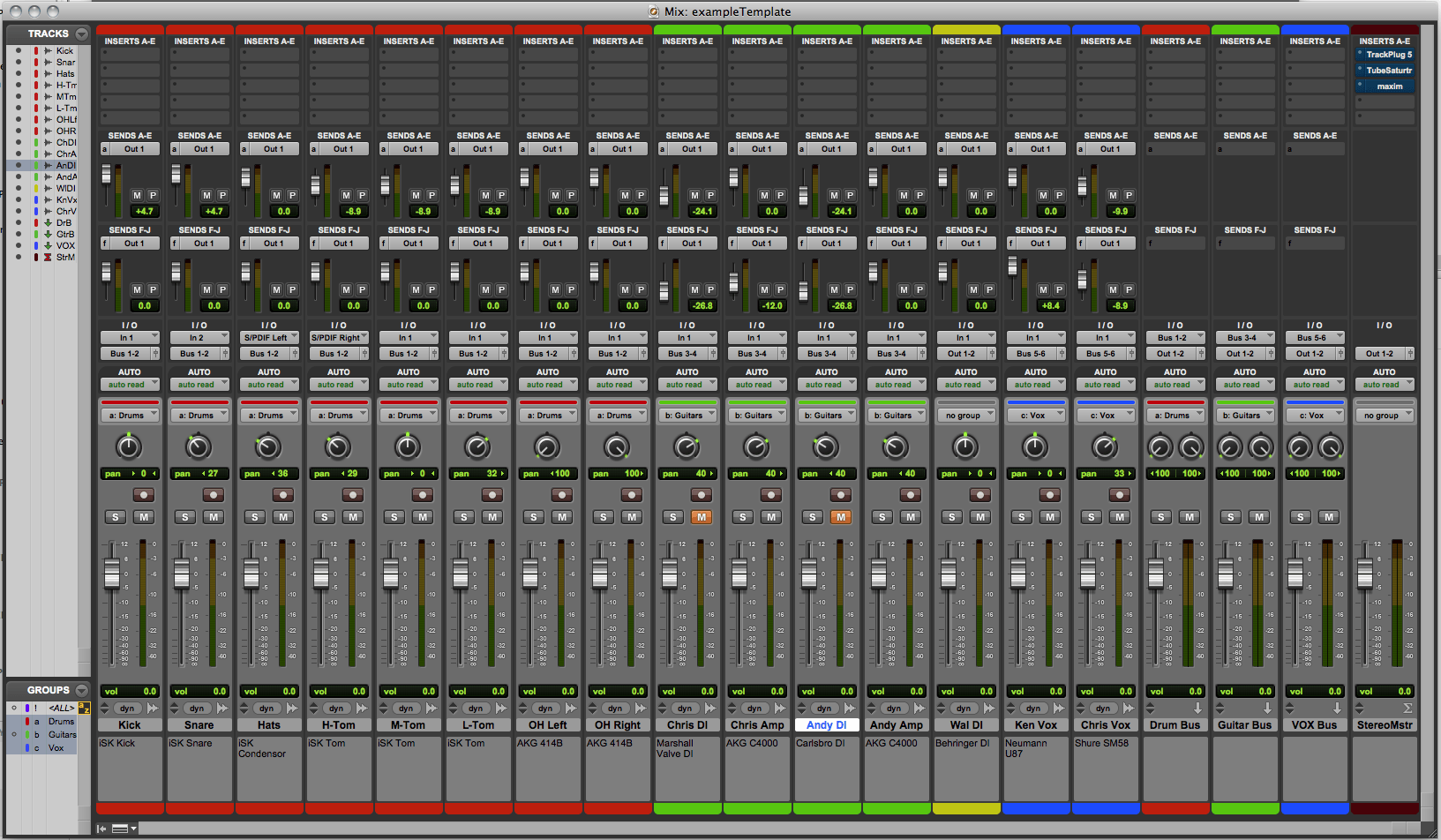
When those parts share common frequencies, that makes the goal of clarity all the more challenging. On most multi-channel audio mixers (hardware or software equivalent), you will have (at least) controls for adjusting the level (volume) of each individual track, panning (adjusts the track within the stereo spectrum from left to right), and EQ controls. Hands down, the most important things to adjust and experiment with in achieving a good mix. Once those elements are under control, you may have access to audio effects such as reverb and delay that give the audio a sense of space in your track. Compression and limiting, which control dynamics, are equally important. There are many more effects available to utilize, but it's really beyond the scope of this post to go any further into it. I've probably gone too far out there as it is! Hope you're still with me...

Virtual mixer screen in Pro Tools, my recording software of choice.

Which brings me back to my main point. When I have access to all these tools to create my mix, it really comes down to the 2 most important tools of all: my speakers, and my ears. You can have the best equipment in the world, but it won't matter a bit if you have not tuned or trained your ears for this kind of work. Training your ear to make good mixes takes practice, making as many mixes as you need to before you get it right.

That's the lesson I learned this past week, for as many hours as I could squeeze in before having to go to bed and return to work the next day. Working on the first of the three songs, I'm happy to say that I've finally completed a mix that I'm pretty darn satisfied with! Certainly all my past experience helped me get to this point, especially remembering what NOT to do! However, I believe it was increasing my focus and persistence that helped me finally come across to the other side and produce a mix that I could live with. This is not to say that I now know all there is to know about mixing - I still have much to learn and improve on. But I believe that it will make the next mix project that much easier to get it the result I want. That next project is coming up soon, as in next week, if not this weekend! I have two more songs to mix, then I'll finally be able to post them online and share them with you folks out there. No concrete time frame as to when that will be; as I like to say, hopefully sooner rather than later! Till next time...

A book on audio mixing that's provided me with a lot of good info:

The Mixing Engineer's Handbook

Monday, September 5, 2011

Recording Piano

Back once again, folks. Today, I thought I would share my recent experience in recording some live piano for the first time, for a song I'm working on. "Live", as opposed to simulated, or "virtual" piano. Why is this special, you may ask? Well, because of the degree to which digital technology has advanced, today you can have virtual versions of just about any type of instrument you can think of in the form of software, available at the click of your computer mouse, and a MIDI keyboard or other device, to play the sounds.

One of the most common and most useful virtual instrument sounds is the emulation of an acoustic piano. Not everyone has the means to purchase a real piano, or the physical space necessary to house one! Not to mention forgiving neighbors, accommodating the noise factor... For that reason, virtual pianos are great to work with, especially with the level of realism being achieved, and continues to improve. The downside is what gets lost when playing virtual piano, and the most important element lost is referred to by some players as "feel". The relationship of the hands with the keys, and the response of the instrument are important factors to a piano player. Playing sampled piano sounds from a MIDI keyboard with plastic keys will probably sound perfectly acceptable for the listener, but it will never feel like a real piano to the musician. It is simply one of those things a modern keyboard player learns to live with particularly when playing live, but is often the case when recording as well, especially at home.

The piano, the way it usually looks
So when the opportunity to record with a real piano came about, I jumped at it! The song I'm working on is mostly based around an acoustic guitar. However, I felt that the song would benefit from a piano part in the middle section (a "solo", of sorts). This was great timing, as my recording equipment had all been recently upgraded and tailored to be more mobile. The piano (an *old* Kawai upright) is located in the den of my parents' house. My mobile equipment allowed me to go to them and record with relative ease. The only thing is that I've never recorded one before! So (like everything else that comes up in my life these days), I did some online research to at least get pointed in the right direction. I found a few articles that gave me some ideas on mic placement, to get the best possible sound.

Setting up

I also wanted to have the right type of microphones for the job. However, when it comes to mics, there are usually several options on what to choose. I decided to go with a pair of Samson CO2 condenser mics. They are small diaphragm mics which, my research told me, tend to capture acoustic instruments quite well, particularly the detail in the upper frequency ranges. Since this recording session was a bit experimental in nature for me, I wasn't prepared to spend a whole lot of money. Fortunately, these mics came as a matched pair, with case and mic stand adapters for $119. A pretty good deal, being that mics of this type typically cost at least twice as much, for a single mic! I haven't completed the track yet, so I don't have a final, concrete opinion on the quality of the mics, but based on what I heard from the playback of what was recorded, the sound was decent enough for me. I'm pretty confident that it will be sufficient for what I need on the song.

The piano is not in regular use by those who live in the house, so the furniture in the den is arranged near the piano pretty tightly, as if it were another piece of furniture itself (sorry Mom & Dad). Thus, a little prep work had to be done before I could get down to business. That consisted of clearing away a loveseat and a coffee table to make some room, and setting up some "TV trays" to set my equipment on. Fortunately, an electrical outlet with a power strip was close at hand to plug in my equipment. I also had to do a quick and dirty repair on the sustain pedal of the piano, which was loose. A rattling sound every time I pressed down on the pedal would pretty much ruin anything I tried to record. Some painter's masking tape wrapped around the pedal did the trick quite nicely for muting the offending noise. The pedal also squeaks a bit, but I didn't have time to figure out where it was coming from, so I did some "tweaking" to my playing technique and used it only when necessary. If I get the chance to record there again, that will be next on my list of fixes.

The recording equipment consisted of my laptop (a 15" Apple MacBook Pro), a Digidesign Mbox 2 USB audio interface, an external FireWire hard drive, and the aforementioned Samson condenser mics. As far as DAW software, I use Pro Tools LE 8. They're up to version 9 now, but I haven't gotten around to upgrading yet.

The recording equipment


Ready to record

Concerning mic placement, I set them over the top of the piano with the lid open, strings and hammers exposed. As the pictures illustrate, one mic covered the lower end of the instrument, the other covering the upper end. The mics were slightly tilted to attempt a good blend of both ends of the piano range. Each mic was recorded to its own separate audio track in Pro Tools. The two tracks should give a nice stereo image when it comes time to mix the song.

Once set up, the recording process was pretty much the same as when I record at home - I do multiple takes, and at some point assess how things are going. In a perfect world, I'd be able to perform the whole part in a single take. In almost all cases, it doesn't work out that way, at least for me. So, I record enough takes until I feel I have enough to piece together an entire section that I'll be satisfied with. In other words, I take pieces that I feel are good from the separate takes and edit them together to create a "master" take. It may seem like cheating to some, but this technique has been used by professionals for decades (yes, even before digital recording), so I don't feel so bad, haha.
Mics pointed toward the inside of the piano

Once I did my takes for the middle section, I decided that I should record some chords in the final chorus of the song. I'm not sure that I'll use it in the final version, but I figured it couldn't hurt to record it, since I was all set up to do so. Another round of takes for that part, and I was done. All that remained was packing up the equipment, and putting the room back the way I found it - don't want my folks regretting having me over to record, because of the mess I made. I may want to come back and record again someday!

All said and done, it was a pretty enjoyable experience, and stress-free. First, because I was only recording a couple of short parts. Secondly (and most importantly), because my parents were kind and gracious hosts, allowing me to record for an afternoon in their home. Thanks Mom & Dad!

Friday, June 3, 2011

Still Here...

Howdy folks... Been a little while since I've posted here, for sure. This one will be more like an update of sorts, compared to my past articles.

I actually have been keeping fairly busy for the most part. In regards to music stuff, I've been working on recording a batch of songs that I've written. Some are old songs in need of updating and improving. Some are more recent, and... I'm still getting down to the business of getting them recorded.

I've always felt various creative struggles in getting my own music together, to the point that I tend not to produce much, compared to others I know and hear about. As a result, my own collection of songs is pretty darn small. I'm definitely not a prolific writer! I find myself going back and forth on how I feel about this. Some days I lament my low output of music, other days I simply accept it for what it is, and be happy that I produce anything at all. It is particularly difficult squeezing in time to work on music when you have a 9 to 5 to go to every day. However, I try not to complain too much because I know I'm only one of millions that are in the same boat.  I just wish someone would fill me in on the secret to getting over that hump. That is, if there *is* one...

Presently I'm in the tracking (recording) and editing stages, and right now it feels like I'm gonna be stuck there forever! That said, things are actually moving along, and progress is being made. Just not as quickly as I'd like, but that's my impatient side talking. These days I squeeze in 2-3 hours' work in the evenings when time, energy and motivation permit, and as much as possible on weekends. With that schedule in place, I hope to have *something* ready for people to hear later this summer. Let's see how I do! If inspiration strikes, I may post some thoughts on the recording process as it moves along.

In more tech related news, I'm curious to see what gets announced at Apple's Worldwide Developer Conference (WWDC). Steve Jobs will make the keynote presentation on Monday June 6th. Confirmed for discussion is Mac OS X Lion, iOS 5, and something called "iCloud", which it's safe to say that it will be some sort of internet-based storage service. Apple usually will put up a webcast of the yearly keynote, so I'm sure Apple geeks (such as myself) are waiting for Monday's keynote with great interest, to say the least.  Also waiting, no doubt, are the Apple-haters, ready and all too willing to get their Apple-hate on!

Which reminds me of my very first blog post... I've had all the necessary parts to convert my old iPod to flash-based storage for a while now, but I just haven't had much time to sit down and get to work on it. But soon, and that will be another post for y'all to check out in the upcoming weeks.  Until next time...

Friday, April 22, 2011

Home Studios - Less Is More.

My name is Scott... and I'm a recovering "gear-aholic". There, I said it. I've put off this admission for a long time, but there's no denying or wishing away what you know to be true...

That simple statement came into my head today, as I was thinking about my ongoing work on my current batch of recordings. I've been doing this home recording thing for well over 15 years now, and I think anyone who's been into it like I have knows that, over time, you start to accumulate... stuff. Instruments. Amplifiers. Recording equipment. Cables and other accessories. If you're not careful, the accumulation of these things can overwhelm, to the point where it becomes a hindrance to your creativity, instead of feeding and nurturing it. I've battled with this "problem" for years, and I feel it's time to finally do something about it.

I started recording music at home back in the early to mid-90's, and though I was a young musician who hadn't been playing any instrument for very long (and couldn't sing all that great either), I was eager to learn. Eager to create something that was important to me, if no one else. I was also driven by artists like Prince and Stevie Wonder, who played most if not all of the instruments on some of their most popular records. That got me excited to see if I could pull off some of that myself someday.

As my short money would allow, I would upgrade to more and more pieces of equipment. Guitars, effects, amps, drum machines, keyboards. But the game-changer was my first 4-track cassette recorder. It was a revelation AND a revolution! It was the last piece of the puzzle to finally give me at least a taste of the sounds that I was hearing in my head, and it was a great learning experience. But what was an even greater lesson was when I met the bandmates of the very first band I played in. They recorded with 4-tracks like I did. But when they played me their songs... It was an eye-opener, on different levels.

The lesson learned then, was to keep it simple. Less is more. In those early days, I was stuck in the trap of trying to make my music sound like it was played by an entire band, when in reality it was just me, and my fancy equipment. Stevie and Prince did it, I can too, right? Well maybe, maybe not. They were the exception, not the rule. And I've come to terms with the fact that I'm not the exception. But it doesn't mean that I can't make music that pleases me, and hopefully others. We shall see how that goes...

My bandmates' music had simple arrangements, the playing was never busy, always to-the-point. But the music had impact, and "vibe". That's what I'm going after, every time I attempt to record, to this day. And over the years, I've discovered more artists' music that follows that same ideal, so I feel that I'm on the right track. I'm learning that lesson a little more every day.

The "less is more" motto applies not only to writing and arranging. For me, it now applies to the equipment that I use. These days, I'm about getting as much of it out of my way as possible. The technology has now advanced to the point to that you can do great recordings to easily share with anyone (without embarrassment), with a bare minimum amount of gear. As recent as last year, I had 2 computers, a multi-channel audio interface, a mixer, a drum machine, and 3 keyboards. All that extra equipment was getting in the way of me getting much work done at all, resulting in a hard drive full of abandoned, half-done ideas. Today, I'm working with a laptop, a basic 2-channel Pro Tools interface, microphones, headphones, speakers, a few guitars, a small MIDI keyboard, and my voice. That's everything I need to get my ideas across.

From now on, if there's something not right with the music, it's gonna be on me, not on what equipment I feel that I "need," and don't have. The recordings should be able to stand on their own, because of the energy that I put into the music, not the equipment. In that respect, I feel very liberated these days. Freedom is a beautiful thing...

2006 - Bad...
2007 - Worse...
2009 - Worst!
April 2011 - Under control once again